The Robinhood Meta, Explained: Why This Memecoin Cycle Is Different
Crypto has spent years recycling the same capital between the same trenches. For most of 2026 the mood has been flat - traders either sitting out or waiting for a reason to care. Robinhood just handed them one. Here is what actually happened, why this meta reads differently from the last dozen, and which tokens are leading it.
The signal that started it
The setup was almost theatrical. On 2 July, Robinhood CEO Vlad Tenev told CNBC that assets without utility do not last - the standard serious-founder line. Six days later, on 8 July, as CASHCAT climbed on his own chain, he posted that while Robinhood Chain is built for real-world assets, "it works great for memes too," and followed the token's account. That reversal functioned as permission. Solana degens moved in fast, and the numbers followed the attention almost immediately.
Within days the chain went from a standing start to one of the most active EVM venues around - DEX volume jumped roughly tenfold and new addresses grew more than twentyfold. A week-old chain pulling that kind of activity is not normal. It is the kind of move that only happens when a credible founder points a crowd at a target.
The launchpad war
Then the launchpad fight began, and it moved just as fast. Noxa led first, out-earning Pump.fun on a daily basis within days - before stopping launches on 11 July and going dark shortly after, having collected an estimated $12M in fees. CASHCAT fell sharply as it did.
The vacuum did not last a day. Pons stepped in and now holds more than half of the launch market, with a peak throughput of around 14,000 tokens per hour. Whatever you make of the quality, the raw velocity tells you where builder and trader attention has rotated.
The tokens leading the meta
A few names carry most of the narrative weight right now. Treat these as a map of where attention sits, not as advice.
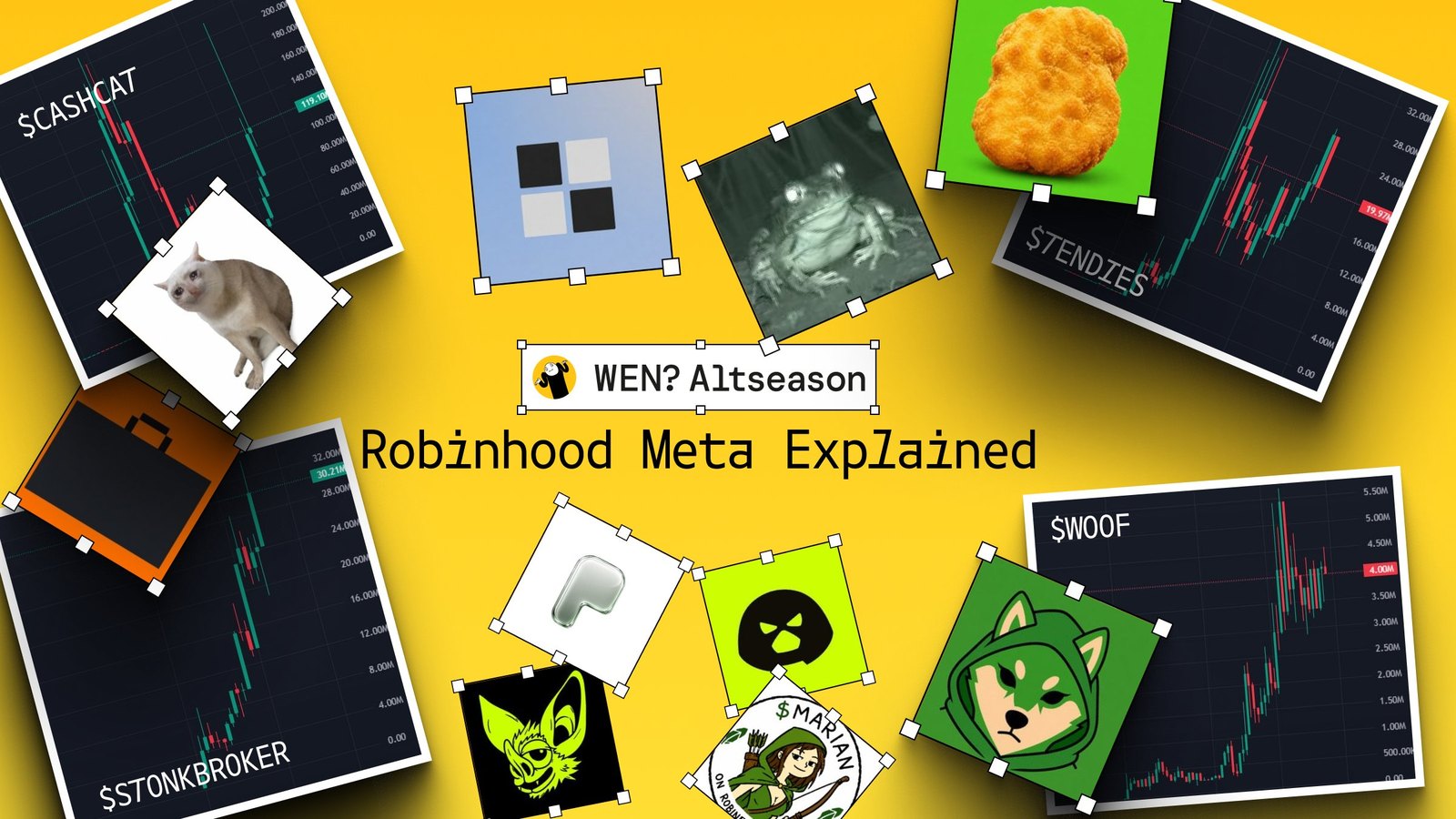
$CASHCAT - the ecosystem flagship
The face of the meta, and named after Robinhood's original working title before it was Robinhood. It peaked near a $156M market cap - briefly touching $200M on 11 July - before settling well below that as the launchpad drama played out. Early positioning paid absurdly well: one anon who bought in days before its Robinhood US app listing reportedly turned about $98k into $215k. Market caps in this meta move fast, so treat any single number as a snapshot.
$STONKBROKER - meme plus infrastructure (~$29.8M MC)
More than a picture. The project ships 4,444 NFT "brokers" built on ERC-6551 wallets that can hold real tokenized equities like TSLA and NVDA. Ansem backs this one too, which is part of why it reads as structural rather than disposable.
$TENDIES - the cultural grail (~$17.4M MC)
The GameStop and WallStreetBets era distilled into a single token. For a Robinhood audience specifically, the narrative fit is almost too on-the-nose - which is exactly why it works.
$INDEX - the dividend play (~$9.5M MC)
The structural outlier. Holders receive tokenized equities - Nvidia, Apple, SpaceX - dropped to their wallet once an hour. Vlad Tenev personally follows the project, a small detail that matters a lot in a meta running on founder attention.
So how real is Robinhood runway?
Honest framing: Robinhood Chain still runs far behind the majors on raw throughput - Solana processes an order of magnitude more transactions per day. That gap is real. But every large ecosystem looked underpowered at some early point, and throughput is a lagging indicator of narrative, not a leading one.
The meta holds as long as two things stay true: a founder who keeps personally amplifying the story, and fresh capital that keeps flowing in. Robinhood has both right now. When either fades, the trade fades with it - that is the honest version, and it is the one worth trading on.
We build narratives and distribution for token launches - the kind that turn a founder signal into real attention. Reply in under 1 hour, custom proposal within 24 hours.
Talk to us →Not financial advice. Do your own research. Figures reflect the situation at time of writing and move fast.