How to Vet Crypto KOLs After the Side-Wallet Exposés
On November 5, Bubblemaps published an onchain investigation into four crypto influencers. A day later it posted a follow-up thread saying the pattern was industry-wide, that "side wallets have become a business model", and that it would soon name one of crypto's largest KOLs. In the same 48 hours, a dump of leaked DMs from a promoter tied to the 2024 celebrity memecoin wave started circulating on X, alleging paid shills by well-known accounts. Those claims are unverified and the people named deny them.
For traders, this is a story about getting dumped on. For founders, it is a budget question. If you pay an influencer whose side wallets sell into the buyers your campaign brought in, you have paid to lower your own chart, in public, with your logo on the post.
This guide covers what the investigation found, why the timing hurts, and the checks we recommend before any project sends a single influencer payment.
What Bubblemaps Found
Bubblemaps describes its findings as analysis and estimates. The patterns it traced across the four accounts:
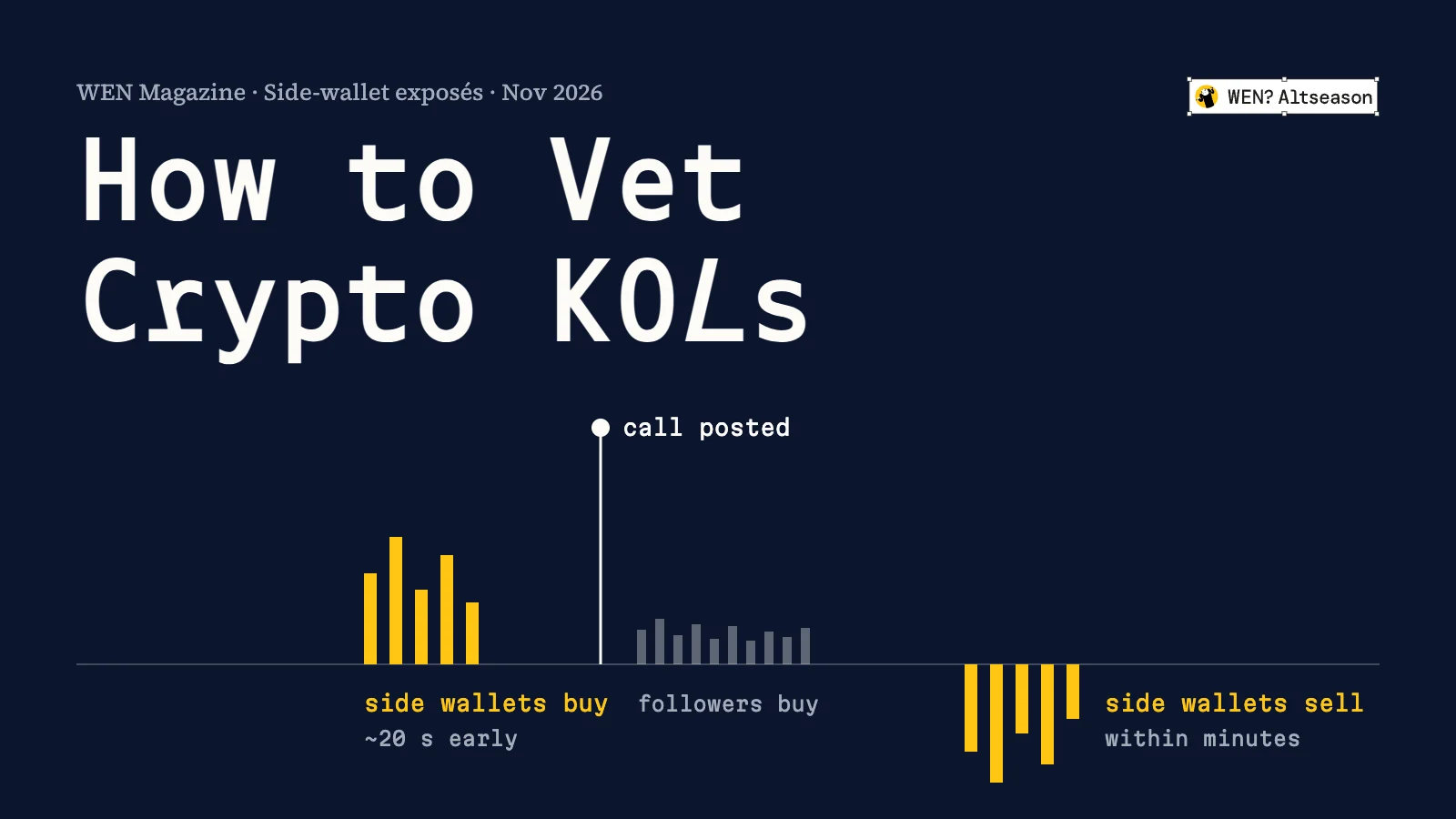
- Buying seconds before the call. In one case, five wallets linked to an influencer bought ahead of 61% of his 534 October calls, about 20 seconds early on average, and sold within minutes.
- Selling while the post is still live. Another account's linked wallets often sold within three minutes of a call. Over 49 calls, Bubblemaps estimates about $125,000 in earnings: $45,000 from trading and $80,000 from platform callout rewards.
- A losing public wallet, a winning private one. For a third influencer with about 200K followers on X, the public wallet showed a $70,000 loss on the tokens examined while connected wallets were up about $270,000.
- Bundled supply. Dozens of fresh wallets bought at similar times, each holding 0.5% to 1% of a token's supply, with thousands of intermediary addresses in between.
Bubblemaps' ask was aimed at launchpads: audit the top traders, expose their side wallets, ban repeat offenders. Its point is that leaderboards, affiliate links and callout rewards pay for volume, and nothing in that setup checks who is on the other side of the trade.
Why It Lands Harder This Month
The exposé arrived in a fearful market. On November 9 the Crypto Fear & Greed Index sat at 29, Bitcoin traded around $75,000, and US spot Bitcoin ETFs had just logged about $1.28B in weekly net outflows, per KuCoin's daily report. On October 29, Binance lost $6.43B across 11 blockchains in an attack the FBI attributed to North Korea's TraderTraitor group, according to Elliptic. And the November midterms handed Democrats both chambers of Congress, which Cointelegraph reports is likely to reopen the market structure bill with more focus on consumer protection.
Thinner liquidity makes any coordinated sell heavier. Budgets are tighter, so a wasted influencer round costs more. And when lawmakers are about to rewrite the rules with retail protection in mind, undisclosed paid promotion becomes the easiest target in the room. We covered that legal side in our token launch legal checklist.
The 8-Step Vetting Checklist
These are the checks we recommend to any project before it signs an influencer, whether it runs the campaign alone or with a partner.
1. Pull their last 30 calls onchain
Follower counts tell you nothing about behavior. Take the influencer's recent token calls and check each token's early buyers in a wallet-clustering tool such as Bubblemaps or Arkham. Fresh wallets that buy seconds before the post and exit within minutes are the pattern this month's investigation documented. If you find it twice, stop there.
2. Get every wallet in writing
Ask for all wallets the influencer and their team trade from, and make the list part of the contract. Add a clause that undisclosed wallets trading your token void the deal and trigger repayment. Honest operators sign this without friction. The ones who argue have answered your question.
3. Set a trading blackout around their posts
Write a no-trade window into the agreement: no buying or selling your token from any wallet they control for a fixed period before and after each post. The exact window depends on your launch, but it has to cover the minutes that matter most, which are the first ones.
4. Pay with vesting attached
If you compensate in tokens, small TGE unlocks and real vesting keep the influencer's incentives tied to your chart a few weeks out. Discounted allocations that unlock at TGE make an early exit the rational move. We have argued for small influencer unlocks with no exceptions for a while, and this month shows why.
5. Require disclosure on every paid post
Every paid post should be labeled as paid. Leaked DMs and onchain receipts now resurface years later, so an undisclosed deal can turn into a scandal about your project at the worst possible moment. Disclosure also keeps you on the right side of the regulators who are reading timelines.
6. Check who the audience is
Look at the replies, the language of the followers, and the regions they come from. When ZachXBT pulled geodata on 70,000+ InfoFi accounts, only 26% came from developed countries. An audience that cannot or will not buy your token is reach you pay for without any return.
7. Be careful with leaderboard and reward farmers
Accounts that rank high on launchpad leaderboards or earn callout rewards are paid by volume. That is the exact setup Bubblemaps flagged. These accounts can still be fine partners, but they need the strictest version of steps 1 to 3.
8. Watch the wallets during the campaign
Vetting does not end at signing. Track the disclosed wallets, and the token's early buyers, during each posting wave. If something moves against the agreement, pause payments the same day and use the clawback clause.
Fewer Influencers, Better Ones
The side-wallet problem scales with the number of accounts you pay. A list of 200 micro-influencers is 200 sets of wallets you cannot realistically audit. For Vooi, we replaced a list of 200 micro accounts with 7 tier-1 CIS names who actually move audiences, and every campaign turned a profit. A short list you can verify beats a long one you have to trust.
That is also how we run our own network: 1000+ influencers we work with directly, plus 200+ alpha groups. Relationships let you ask for wallets, blackouts and vesting without losing the deal. A rate card never gets you that.
If you are planning a campaign, our breakdown of what crypto KOL campaigns cost covers budgets and fees, and our KOL and influencer marketing page shows how we structure them.
The Short Version
Before you pay any crypto influencer this cycle:
- Check their last 30 calls for pre-call buys.
- Get every wallet in the contract.
- Set a no-trade window around each post.
- Pay with vesting.
- Label every paid post.
- Verify the audience can buy.
- Treat leaderboard farmers with extra care.
- Monitor wallets through the whole campaign.
The investigation's main target has not been named yet. When that name lands, the projects that vetted their influencers will have nothing to explain.
This article is not legal or financial advice.
Need influencers you can actually verify? Talk to us.
Sources: Bubblemaps: Crypto KOL Moves Onchain (Nov 5, 2026) · crypto.news on the Bubblemaps follow-up (Nov 7) · TokenPost on launchpad audits (Nov 8) · KuCoin Crypto Daily Market Report, Nov 9 · Elliptic on the Binance hack · Cointelegraph on the CLARITY Act after the midterms