
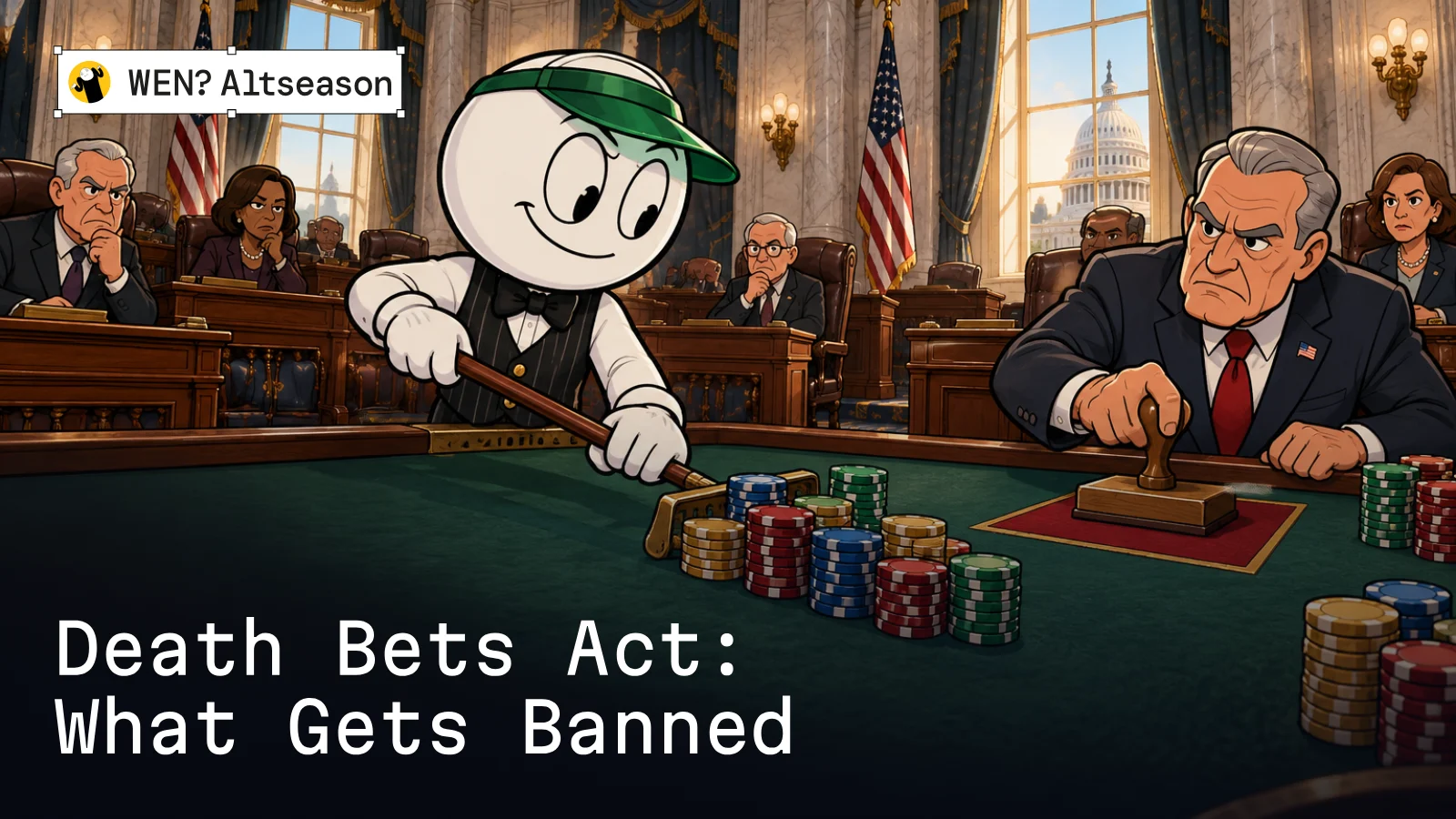
Death Bets Act Explained: The Senate's Prediction Market Ban
Published November 20, 2026
On November 19, the US Senate passed the DEATH BETS Act, a bipartisan bill that bars federally registered exchanges from listing prediction contracts on war, terrorism, assassination or individual deaths. It now goes to the House.
On the same day, Bloomberg reported that Coinbase plans to launch its own US prediction market contracts in the first half of 2027. Its prediction business already brings in more than $200M a year in net revenue.
Washington is drawing lines around prediction markets at the same moment the biggest US exchange is doubling down on them. Here is what the bill does, what it does not do, and what it means if you are building or marketing a prediction market.
What the DEATH BETS Act Does
Per CoinDesk's report:
- The bill: S. 4035, introduced in March 2026 by Sen. Adam Schiff (D-Calif.) and co-sponsored by Sen. John Curtis (R-Utah).
- What it bans: it amends the Commodity Exchange Act so federally registered exchanges cannot list contracts on war, terrorism, assassination or individual deaths, including contracts tied to events such as US military operations.
- Penalties: none new. Violations would fall under existing commodities law and CFTC enforcement.
- Status: passed the Senate on November 19, now heads to the House with no set timeline.
Schiff's argument was insider trading and national security: such contracts, he said, "create rampant opportunities for insider trading."
Why Now: The Cases Behind the Bill
The bill follows a string of incidents where traders appeared to profit from information others did not have:
- Iran strike bets: in February 2026, six Polymarket wallets made about $1.2M betting on the timing of US strikes against Iran, according to Bubblemaps. The traders were never identified.
- Venezuela: federal prosecutors charged a US Army Green Beret who allegedly traded on classified knowledge of a military operation in Venezuela.
- Kalshi enforcement: Kalshi fined two traders, one more than $20,000, and banned them for two years for trading on confidential information.
What the Bill Does Not Do
The headline sounds bigger than the change:
- It does not ban prediction markets. Elections, sports, crypto prices, economics and culture contracts are untouched.
- It mostly writes existing practice into law. CoinDesk notes that such contracts are already a disallowed category the CFTC can block.
- It applies to federally registered exchanges. Offshore and onchain venues are a separate fight, which the CFTC addressed the same week.
- It is not law yet. The House still has to pass it.
The Same Week in Prediction Markets
The bill is one of several moves this week that define where prediction markets can operate:
- Coinbase goes in-house. It targets the first half of 2027 for its own US contracts, for retail and institutional customers, while keeping its Kalshi partnership. Its prediction business passed $200M in annualized net revenue, compounded 82% quarterly revenue growth since launch, and more than half of Q3 trades were on non-sports contracts.
- The CFTC on onchain venues. Chair Michael Selig said Hyperliquid and other onchain platforms can reach US retail users, but only with a license or a registered-exchange partner, with no special rules, per CoinDesk and The Block.
- States push back. A federal appeals court, the Fourth Circuit, upheld Maryland's authority to regulate Kalshi under its sports betting laws. New York's attorney general sued Coinbase and Gemini in April over alleged unlicensed gambling.
- Coinbase backs a line between trading and gambling. It supported a CFTC proposal to distinguish prediction contracts from gambling.
Onchain Markets Just Proved Their Point
The week also delivered the best argument prediction markets have. Anthropic opened on Nasdaq on November 19 near $111.50, 34% above its $83 IPO price. Hyperliquid's pre-IPO Anthropic futures had traded within 1% of that opening price, with about $1.7B in 24-hour volume, per Cointelegraph and CoinDesk. We covered how those markets worked in Anthropic IPO and Crypto.
That is the case prediction markets make to regulators: crowds with money at stake price events well. The DEATH BETS Act is the counterweight: some events should not be priced at all.
The Market Around It
The prediction market news landed in a weak tape:
- BTC slipped to around $61,000-61,500, a four-and-a-half-month low and about 25% below a month ago.
- ETF outflows: spot BTC ETFs lost $582M in one day, the most in three weeks, with BlackRock's IBIT posting a record $541.1M outflow. November outflows are near $3.5B, per The Block.
- Policy: top lawmakers say the CLARITY market structure bill is likely dead until 2027.
For the full backdrop, see Why Is Crypto Crashing? 7 Reasons.
What It Means for Prediction Market Projects
Prediction markets are one of the few crypto sectors growing through this drawdown, and the rules are getting clearer. That changes how projects in the space should market themselves.
- Lead with accuracy and research. The strongest pitch for prediction markets is that they price events better than polls or pundits. Data-driven content proves that better than any ad. For Trendle, we built long-form prediction-market research amplified by our influencer network, which took the project from zero to top-3 mindshare in 30 days, behind only Kalshi and Polymarket.
- Stay out of the banned categories, in markets and in marketing. Never promote war, death or terrorism contracts, and avoid creative that jokes about them. One screenshot can put your project in the next Senate hearing.
- Know which users you can reach. The CFTC's message is clear: US retail needs a license or a registered partner. Geo-target campaigns accordingly, and check our token launch legal checklist before you brief influencers.
- Build a brand around your market. With Coinbase, Kalshi and Polymarket competing for the same users, liquidity follows attention. Daily presence on X, explainers on how your markets resolve and visible community debate keep you in the conversation. Our crypto social media and influencer marketing work is built for exactly that.
- Turn big events into live content. Elections, Fed meetings and IPOs are when prediction markets get attention. A live X Space during the event, with traders explaining where the odds moved, turns a news spike into followers.
For more on the sector, see our recaps on prediction markets and accuracy and the investor edge in prediction markets.
FAQ
What is the DEATH BETS Act?
A bipartisan US Senate bill, S. 4035, that amends the Commodity Exchange Act to bar federally registered exchanges from listing prediction contracts on war, terrorism, assassination or individual deaths.
Did the Senate ban prediction markets?
No. The bill only covers contracts on war, terrorism, assassination and deaths. Contracts on elections, sports, economics and crypto prices are not affected.
When did the DEATH BETS Act pass?
The Senate passed it on November 19, 2026. It now goes to the House of Representatives.
Who sponsored the DEATH BETS Act?
Sen. Adam Schiff (D-Calif.) introduced it in March 2026, with Sen. John Curtis (R-Utah) as co-sponsor.
Is Coinbase launching its own prediction markets?
Bloomberg reported that Coinbase targets the first half of 2027 for its own US prediction market contracts, while keeping its partnership with Kalshi.
This article is for information only. It is not legal, financial or investment advice.
Building a prediction market? Talk to us.
Sources: CoinDesk: Senate approves DEATH BETS Act · crypto.news: Coinbase targets 2027 for its own prediction markets · CoinDesk: Coinbase prediction markets · GTokenTool crypto digest, Nov 20 · Liqwall market news, Nov 20